Image Map
Showing posts with label American History. Show all posts

Mayflower Diagrams

Friday, March 25, 2016


We recently started reading about early English colonies like Roanoke, Jamestown, and Plymouth. Colonists had to have amazing constitutions to survive life in the new settlements, but what has been more amazing to my students (and me) is the trip from England to the new world on the ship.

We did a little extra digging into the voyages on ships like the Mayflower. The Mayflower was a merchant ship and not really intended for voyagers. The 102 passengers mainly stayed in the gun deck or "tween" deck in a space that was about 80' long, 24' wide, and a ceiling height of about 5 1/2'. To give you a little comparison, a school bus is usually 40' long, so the Mayflower is the length of two school buses parked one in front of the other.
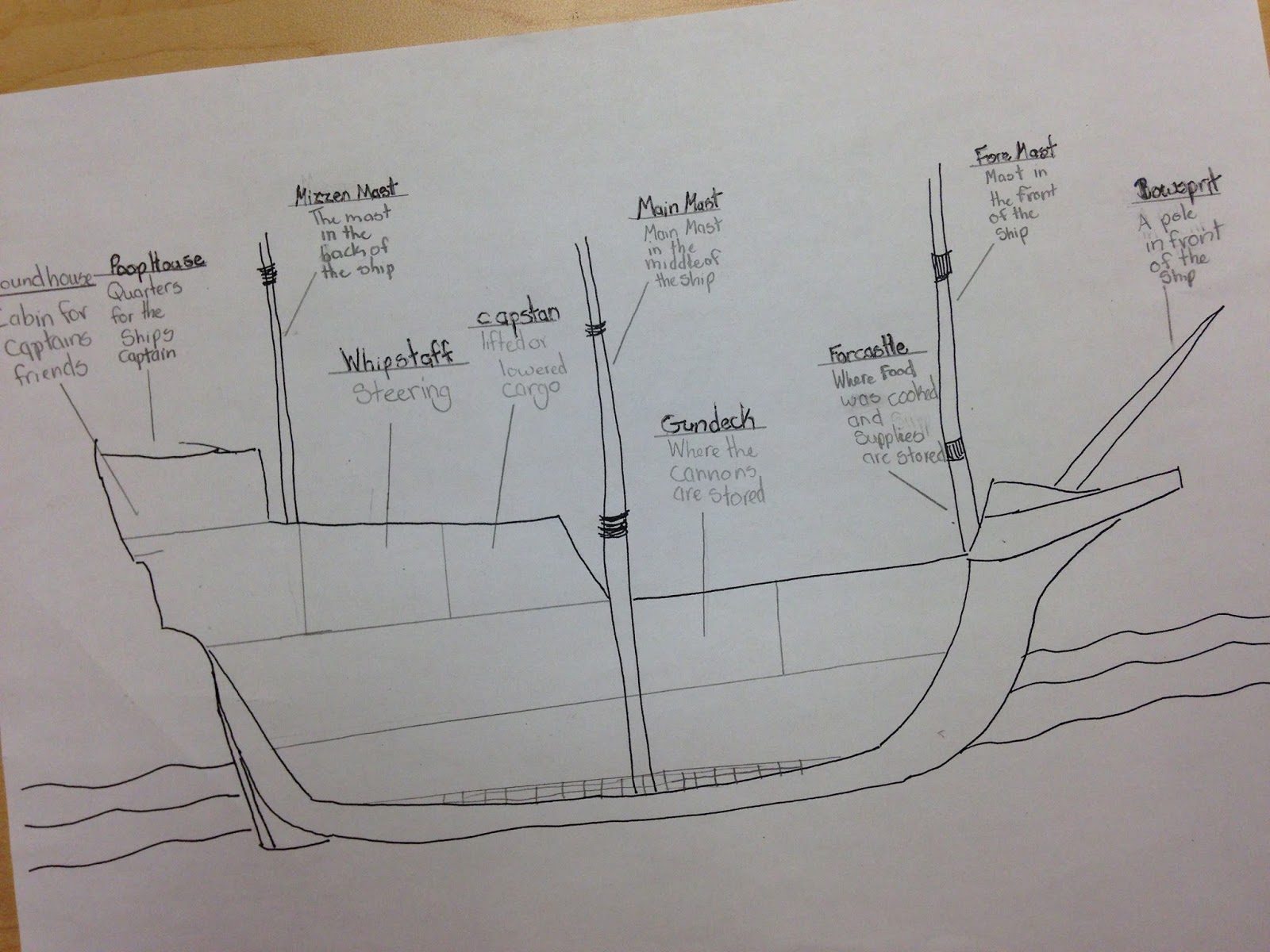

In order to visualize the parts of the ship a little better, the students are creating cutaway Mayflower diagrams with 14 main ship parts labeled. We defined the ship parts first and then searched Mayflower diagrams and pictures to draw our own cross-sections of the ship.


I found this SITE and this SITE with reliable definitions for the students, but there were plenty of other online resources. Google images had great results too. I gave the students this Mayflower Ship Parts Handout, and they completed the definitions first. After we compared definitions, students used legal sized white paper (and rulers) to draw, label, and color their diagrams. We did not quite finish before spring break, but I love the way the diagrams look so far. This has been a great activity to enhance my history content as well as work with proportion and measurement.

Caitlin
The-Room-Mom.com
https://www.teacherspayteachers.com/Store/Theroommom

Activities for Celebrating Dr. Martin Luther King, Jr. With Upper Elementary Students

Monday, January 12, 2015

I took this photo over the Christmas break during a road trip to Hot Springs, Arkansas.  When I saw it, I just had to stop because I knew we would be learning about MLK Jr. in January.  I love sharing school-related photos taken during road trips.  I took lots of pictures of sedimentary rock layers, too.  But that's for a different post!  --The Pensive Sloth
Monday, January 19th will be Martin Luther King Jr. Day.  Many 4th, 5th, and 6th graders can tell you a little bit about MLK, but as upper elementary teachers we want them to go deeper than that.  Here's what a few of the Lesson Deli teachers are doing in the classroom to commemorate this civil rights hero. 
  • The Pensive Sloth--I think it is important that students know how far we have come in our country, and that a large part of that is due to the efforts of civil rights leaders like Dr. Martin Luther King, Jr.  We do a variety of things in the classroom during the week of January 19th. 
    • I like to start by asking students if it is ever OK to disobey a law before we begin discussing topics like civil disobedience and nonviolent protest.  This is a great discussion starter! 
    • We then make a foldable to tell about life before and during the Civil War of the 1860s, from the 1860s to 1960s, after the 1960s, PLUS I have students tell about what life is like today! 

    • For lengthier topics, like the Little Rock Nine and the Montgomery Bus Boycott, students work in partners to prepare a short report to present to the class.  As reports are presented, students summarize each topic on a portable Civil Rights Movement folding word wall.  

    • Finally, I like to end by having students write about what Dr. King would think now.  What would he be proud of?  What would he think needs work? 
  • TheRoomMom, has her students write simile poems about MLK Jr. after learning about him.  First, using a group of words related to MLK, students order the words from most important to least important based on their opinions.  Students then choose the 3 words they value as most important and write a simile using each word.  The similes can be combined into a poem and published on a paint strip for fun!  You can find the free resources for this activity HERE


  • Caitlin also plans to try something new this year--a choral reading with parts of the "I Have a Dream" speech.  What a powerful, simple idea!  Make several copies of the speech and do a dramatic reading in class.  Then, show the speech on YouTube.   
  • JB Creations says, "I like to embrace Dr. King's belief and dream to include everyone! On MLK day, I hand out 3 different scripts for a reader's theater on the life and time of this great leader. The scripts are leveled with a modified, regular, and enriched version to ensure everyone has a chance to participate at his/her own reading level. Students will learn about Martin Luther King Jr's childhood & the beginning of his dreams, his work, dedication, & accomplishments as a civil rights activist, and his lasting influence on people today!"  You can find the scripts JB uses on Teachers Pay Teachers

  • Erin Beers also uses reader's theater to help students learn about MLK Jr.  Students use the script to complete a variety of activities including context clue word work, journal writing, and figurative language practice.  You can find the resource here.  She offers lots of opportunities to address CCSS while studying MLK Jr. 

Time to teach!

--The Pensive Sloth

Revolutionary Thinking Maps: The Declaration of Independence

Thursday, July 10, 2014

I'm super excited to start the first of a series of posts on how I use Thinking Maps (graphic organizers) in my classroom to teach about the American Revolution.  5 things you should know about Thinking Maps--


1.  They provide students with a way to visualize and make sense of new content.
2.  If you teach them early in the year, students begin to use them independently.
3.  They are great for interactive notebooks.  Seriously great.
4.  You don't have to make copies to use them.  Pencil, paper, done.
5.  You can use them with all content.  Check out my Thinking Maps board on Pinterest for some ideas.  

Let's start with the Brace Map.  Brace Maps show part to whole relationships.  When teaching the Declaration of Independence, I love to have my 5th graders start with the primary source.  The actual document.  It's quite overwhelming at first glance.  Fancy language and unfamiliar words abound!  So, I start by drawing the skeleton of the map, showing students that we can look at the Declaration of Independence in four parts.  Then, we are able to read through and stop, summarize, and connect to what we've learned about the events leading to the American Revolution.  Check it out, below! 


Come back soon for more on using Thinking Maps to teach about the American Revolution.

--The Pensive Sloth
Blog
Facebook
Pinterest