Image Map
Showing posts with label novel units. Show all posts

Novels...to Test or Not to Test?! A Novel Resource Round-Up LINKY

Monday, January 19, 2015


As a language arts teacher I always love encountering other upper elementary language arts teachers in other districts and states because I love hearing what takes place in other classrooms.  Questions I seem to find myself asking most frequently:

What novels do you love to teach?
How do you group kids?
Do you utilize a reading program? 

With so many tests being administered to my students on a daily basis one thing I NEVER assess my students on are the novels they are reading.  Perhaps this sounds crazy, but here is a breakdown of a typical week on my 6th grade instructional team...Pro-Ohio reading assessment, Pro-Ohio math assessment, weekly reading fluency assessment, weekly math assessment, spelling test, and maybe a science or social studies test.  EVERY WEEK!  So when we complete a novel unit as a whole class or students complete a novel independently, I seek out project-based resources for my students to complete to extend their learning.

This is my favorite sight in my classroom...


As a language arts teacher, I have spent countless hours sitting in the book store hovering over pages of different novels in hopes of finding the perfect tales to engage my students and make them enthusiastic readers.  I want them to reach the point in each novel where putting the book down is the hardest challenge they face, not worrying about the assessment at the end to check their comprehension.  To enhance their reading ambition, I created this I'm Finished...End of Novel Projects for Grades 4-6 resource in order to make completing novels even more fun for my students.
Click on the image for a sample project:

https://drive.google.com/file/d/0B0WRApjFnFcTUnZNdklOekQxdUk/view?usp=sharing

Teaching for 15 years makes a teacher wise…As teachers we are always looking for resources to make our students’ time in the classroom most meaningful and productive.  Like you, I don’t have a moment to waste with my instructional time.  Rather than TEST, complete some sort of book report, or answer MORE reader response questions, I want them to extend their thinking as well as share what they have learned and enjoy sharing about the book that has just been completed.  My hope is that another student might find the project so intriguing, they can't wait to read that book as well.
 
I would love for you to comment, link up a blog post, or link any free or paid resource that you utilize in your classroom to reinforce a love of reading in your classroom...
post signature

Dear Diary... I want my boy students to read more.

Wednesday, January 7, 2015

OrigamiYoda_Cover

Looking for book recommendations that boys will devour? Suggest book titles that are a hybrid of the diary book format and a graphic novel.

What features will these books have?
  1. The book is written in 1st person, and the speaker has a conversational "kid-speak" voice (very casual).
  2. The main character is usually not a popular kid at school and has social dilemmas.
  3. Most books have a graphic element to them. They include doodles and cartoon drawings in the margins and/or images that make the page look like a piece of notebook paper. They often have fun fonts.
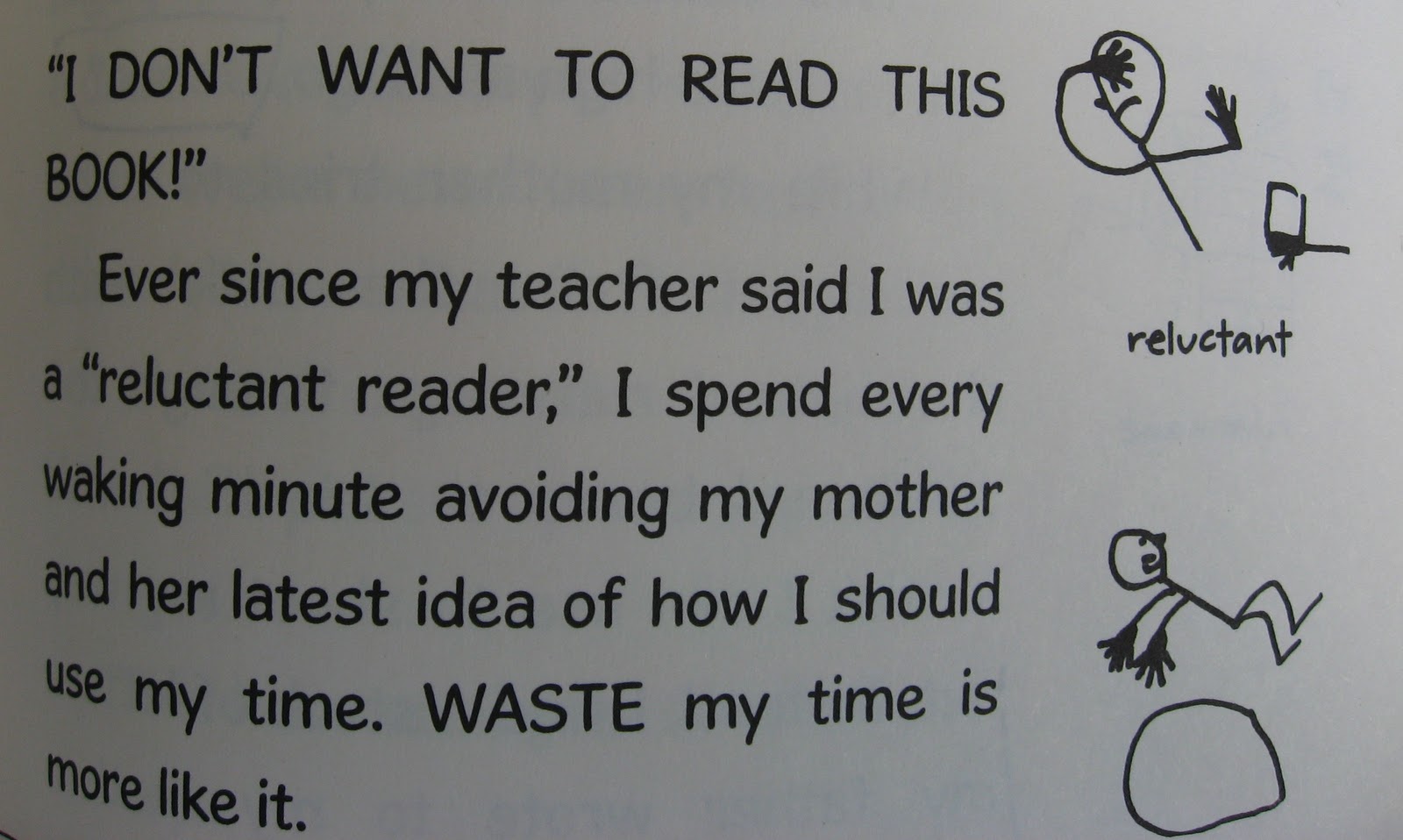
  4. The main character is usually a reluctant reader or a struggling student in some way.
  5. There is a lot of white space on the page, and it is easy to finish the book quickly.
  6. And here is my final little observation. The majority of the books have a male main character-- especially the ones targeted at 3rd+ grade levels.
my life as a book
  • The Strange Case of the Origami Yoda series by Tom Angleberger
  • The Great Hamster Massacre series by Katie Davies
  • I Funny: a Middle School Story series by James Patterson
  • What the Dog Said by Randi Reisfeld
  • The Creature From My Closet series by Obert Skye
  • My Life as a Book series by Janet Tashjian
  • Justin Case series by Rachel Vail
  • Stick Dog series by Tom Watson
  • Timmy Failure series by Stephen Pastis
  • Love That Dog by Sharon Creech (click for novel unit)
  • Hate That Cat by Sharon Creech (click for novel unit)
  • Diary of a Worm series by Doreen Cronin (picture book)

Here are a few additional book recommendations that are in a letter style rather than a journal or diary format.
  • Dying to Meet You series by Kate Klise (click for novel unit)
  • Regarding The Fountain series by Kate Klise
  • Letters from Camp by Kate Klise
  • The Naked Mole-Rat Letters by Mary Amato
  • Sarah, Plain and Tall by Patricia MacLachlan (click for novel unit)
  • Dear Mr. Henshaw by Beverly Cleary
  • The Gardener by Sarah Stewart (picture book, click for activities)

After reading a book that has a letter/diary component to them, review parts of a letter and write to the author of the book. My students and I write one author as a group at the beginning of the year. We research the author's contact information together and send a batch of letters. After that, I use the project as an early finisher activity. If students need an independent activity, they hunt down an author's e-mail address, physical address, or publisher's address and create a letter to the author. We send and receive AUTHOR LETTERS all year and post the letters in the classroom. It is a great way to motivate reading.
Another easy classroom activity is to have students write from the point of view of a main character and prepare an additional diary entry or letter that could be in the story. The students can choose to add their entry to the beginning, middle, or end of the story. The additional writing should address a question or problem that the story left unanswered, so the students have an opportunity to draw conclusions based on the text.

Happy Reading!
TheRoomMom

Man's Best Friend

Sunday, November 16, 2014

I have a student this year who is on the hunt for all chapter books with a dog. As luck would have it, I happen to teach a few books that have a dog as a central character. Books with dogs are great books to share with your class because it is usually easy to get both boys and girls interested in the story.

The dog and main human character rely on each other and develop a deep friendship, and the human (usually a child about the same age as our students) has to take responsibility for the animal. These themes of companionship, trust, responsibility, and independence can be found in many animal books and are reasons I think kids love to read books with animal characters.

One drawback to the dog books is often an animal dies, so be aware if you have a particularly tender-hearted teacher student in your class who might start crying in front of others at the end of the story. 
Below is a list of dog-centered chapter books that I like to use in the classroom as a read aloud or novel study: 

A few favorite activities I use with the dog books I teach could easily be adapted for other novel studies:
One activity I have been using for a long time is to have students write point of view journals as we read a novel. It is an activity that works well for different novels, but it is particularly successful with The Incredible Journey.

Students pick one animal after reading the first few chapters of the book. After we complete each chapter, the students retell the chapter from the point of view of their chosen animal. We share one journal from each animal every day and compare the different versions of the story depending on which animal's journal we hear. Students love comparing and contrasting the scenes in the story based on Luath, Bodger, or Tao's viewpoint. Students also love making the foldable burrito books that they use to write their incredible journals!


Another great assignment to help with citing textual evidence is to have students draw a "map" of a specific character's journey based on details in the text. With the novel, Stone Fox, students draw and label the race course based on clues in the story. There are many novels that involve a journey of some kind, and drawing and labeling the character's route using details from the story is an activity that requires close reading.

Do you read any animal books to your students? Are they successful?

Caitlin